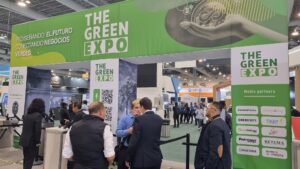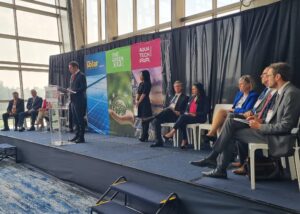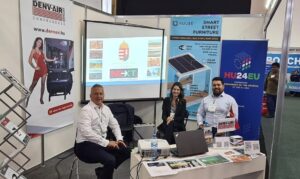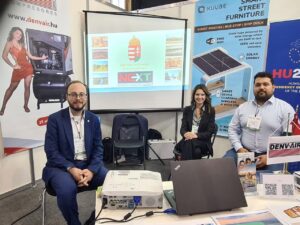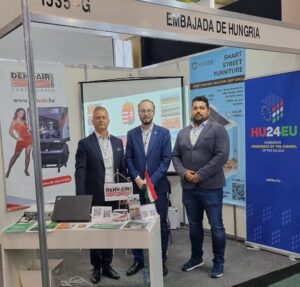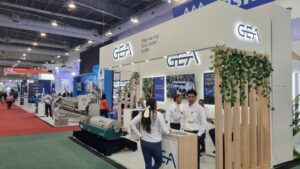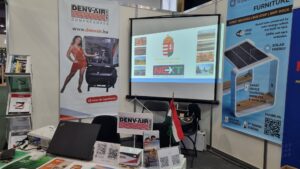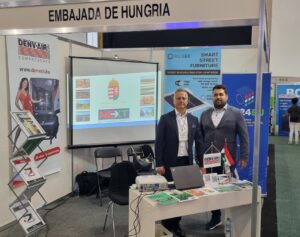




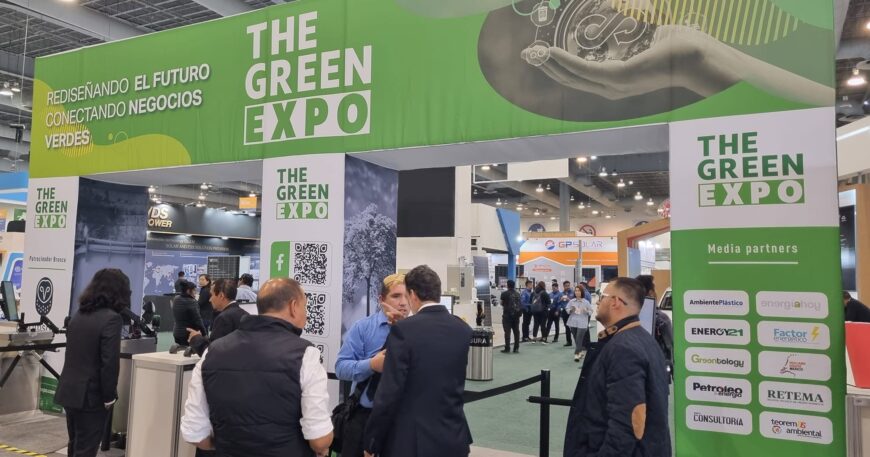
Mexico City hosted the next Latin American appearance of DENV-AIR’s international team. At THE GREEN EXPO industry event, we presented our latest CARBON LINE screw compressor technology and the significant energy-saving opportunities in industrial compressed air production.
Following our successes in Cuba and the Dominican Republic, Mexico was next: a market where energy efficiency, operating cost reduction, and sustainable industrial technologies play an increasingly important role.
Our message is simple:
the cheapest energy is the energy you don’t have to use.
THE GREEN EXPO – Sustainable Technologies in Mexico City
THE GREEN EXPO is one of Mexico’s leading environmental and energy technology industry events. The exhibition focuses on energy efficiency, circular economy, waste management and recycling, as well as hydrogen, wind energy, biomass, and biogas, among others. thegreenexpo.com.mx
This event provided an ideal environment to showcase one of DENV-AIR’s most important development directions:
how to meet the same industrial compressed air demand with significantly lower energy consumption?
The answer does not lie in a single technological element. The efficiency of the entire compressor system must be optimized.
CARBON LINE – When Everything Serves Energy Efficiency
DENV-AIR developed the CARBON LINE screw compressor family specifically with high energy efficiency in mind.
The system combines several advanced technologies:
- permanent magnet synchronous motors,
- two-stage compression,
- 100% direct drive,
- separately inverter-controlled compression stages,
- continuous speed control,
- precise, stable pressure level maintenance.
In the CARBON LINE, two separate compression units operate, each with its own permanent magnet motor and inverter control. The first stage performs pre-compression, while the second performs final compression, with the control system adjusting the operation of both stages to match actual air demand. DENV-AIR Kft.
This fundamentally differs from the approach where a compressor runs continuously at nearly the same speed, regardless of instantaneous compressed air demand.
What Does This Mean for Energy Consumption?
Based on DENV-AIR’s own operational and testing experience, significant savings were achievable with previous DAPM systems through the combination of permanent magnet motors and speed control. The CARBON LINE’s two-stage compression further develops this technology.
In facilities with variable compressed air consumption, the CARBON LINE can achieve up to 40–50% energy savings under appropriate operating conditions compared to a conventional fixed-speed system.
However, it is important not to treat this as a general 50% promise automatically applicable to every facility.
Actual savings are determined by factors including the facility’s air consumption profile, the current compressor’s efficiency and control, required pressure level, network losses, and the compressor’s loaded and unloaded time.
Therefore, energy efficiency must be measured, not assumed.
Why Is Precise Pressure Level So Important?
In compressed air systems, one of the less visible yet important elements of energy efficiency is the proper setting of the required operating pressure.
The goal is not to produce unnecessarily high pressure just to ensure the required value is available at the most distant point in the network.
The CARBON LINE’s intelligent control therefore strives to maintain the most stable pressure level possible, while the two inverters optimize the operation of the compression stages.
The goal is not to produce more compressed air. The goal is to produce exactly as much as the facility needs – with the lowest possible energy consumption.
Energy Efficiency Is Not Just an Environmental Issue
While THE GREEN EXPO’s central theme is sustainability and energy transition, energy efficiency also has very direct economic significance for an industrial company.
Every kilowatt-hour saved reduces operating costs.
This is particularly important in compressor technology, where equipment can operate for many years, potentially across multiple shifts. Even a small difference in efficiency can add up to significant costs over the machine’s entire lifecycle.
Therefore, when selecting a compressor, it is worth comparing not only the purchase price, but also the total lifecycle cost and specific energy consumption.
Mexico After Cuba and the Dominican Republic
The Mexico appearance also represents further expansion of DENV-AIR’s Latin American presence.
Cuba has been an important market for us for more than two decades, and we are continuously building our professional and commercial relationships in other countries in the region.
In Mexico City, we therefore did not simply present a new compressor.
We represented the technological direction that industrial production energy consumption should not be accepted as a given.
It must be measured.
It must be analyzed.
And where possible, it must be reduced.
The DENV-AIR CARBON LINE was created precisely for this purpose.
Up to 40–50% energy savings. Two-stage compression. Permanent magnet motors. 100% direct drive. Intelligent speed control.
Manage energy wisely!