




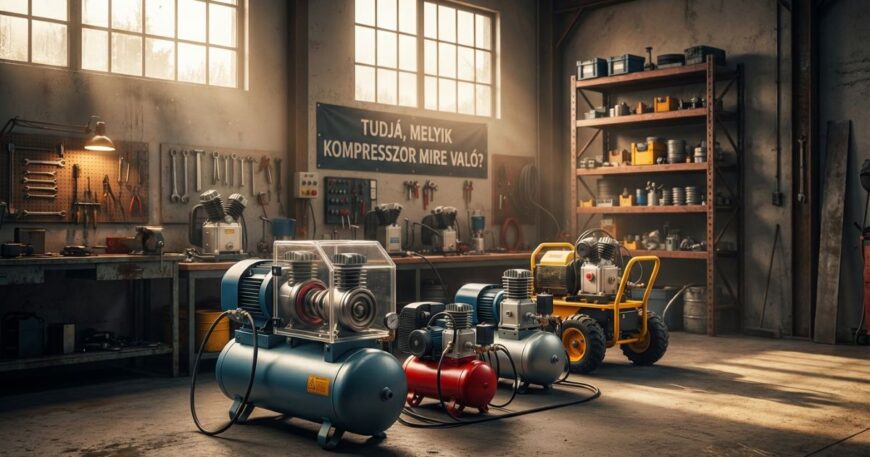
Whether for home DIY or industrial use, compressors are a frequently discussed topic. While the equipment was previously known simply as a gas densifier, today, a remarkably wide range of compressors is available on the market.
When making a selection, in addition to prices, it is advisable to consider the intended future use. Prices vary depending on performance, but the reputation of a particular brand is also a significant factor. We primarily distinguish between piston compressors and screw compressors, which include types suitable for the toughest industrial applications alongside those used for DIY purposes.
Compressors operate very similarly to pumps, with the difference being that while the latter use incompressible liquids during operation, compressors utilize gases. Let’s explore what you should know about the different types of compressors!
When making a selection, in addition to prices, it is advisable to consider the intended future use. Prices vary depending on performance, but the reputation of a particular brand is also a significant factor. We primarily distinguish between piston compressors and screw compressors, which include types suitable for the toughest industrial applications alongside those used for DIY purposes.
Compressors operate very similarly to pumps, with the difference being that while the latter use incompressible liquids during operation, compressors utilize gases. Let’s explore what you should know about the different types of compressors!
Screw Compressors with Various Performance Levels
Delving deeper into the world of screw compressors, it immediately becomes clear that experts readily recommend even the 5.5-10 horsepower versions for smaller plants. In the case of industrial use, energy-efficient operation is of paramount importance, and manufacturers keep this in mind during their developments. Screw compressor specialists have stated that the 10-20 horsepower versions fall into a higher performance category, proving to be an excellent choice for larger plants. In many cases, legislation also mandates their use to ensure a consistent and reliable air supply. Similarly, this equipment is indispensable in the refrigeration and woodworking industries, and certain industrial tasks, masonry, and painting activities also require the availability of a high-quality, reliably operating screw compressor.
When choosing, in addition to prices and energy efficiency, it is advisable to select a reputable brand. This helps avoid astronomical repair costs. Durable quality is also of great importance in this field, and the cost of spare parts in case of a malfunction is another crucial consideration.
Piston Compressors: From Hobby Use to Dental Applications
V-belt driven compressors operating at approximately 1-3 horsepower are ideally suited for workshop and home use. In such cases, you might even be satisfied with so-called dry types, which are more affordably priced, and since they won’t be in constant use, their simpler, oil-free design will meet expectations. In contrast, for industrial use, involving larger volumes and more powerful work, internal combustion engine compressors are recommended. Thanks to their inflatable, rough-patterned tires, these can also be easily moved even on challenging terrain.
Piston compressors also play a role in the cosmetics industry and dentistry, where the most important requirements are high quality and quiet, smooth operation. If you are looking for the ideal unit for such an application, ensuring extremely high-quality air is an indispensable feature.
Given the wide market offering for compressors, it is worth considering the intended purpose of future use in addition to the price-performance ratio. This is crucial not only for the compressor type but also for its expected performance. With products from well-known, proven brands, you can be confident in both long-term use and any potentially necessary repairs!
Source: http://www.szon.hu