




After the dry and hot summer, the cooler and much wetter autumn has arrived. The often sudden, heavy rainfall can be as detrimental to our gardens and habitats as scorching heat and water scarcity. At times like these, we often ponder how beneficial some of the flood and excess surface water could be during a drought.
- How?
- What for what?
For every house with a garden, water provides ample work and tasks. If there is water, it’s for one reason; if there isn’t, it’s for another. Most gardens feature dug or drilled wells, the water from which can be tested by local water utilities or specialized laboratories. Based on the results, it can then be used for irrigation, cleaning, or even cooking and consumption. Accredited laboratories always provide a report on the tests and evaluate the results, indicating any potential problems. Depending on the intended use, you can choose from a wide range of well pumps and submersible pumps.
Consider the following questions before making a purchase.
- From what depth do we need to draw the water?
- To what height do we need to deliver the water?
- How much water do we need, what flow rate is required? (For household water supply, typically 20-30 liters/minute; for irrigation, approximately 40-50 liters/minute will be needed)
- How far do we want to transport the water through the pipes?
After accurately measuring the diameter of your well, seek out a specialized retailer where the staff can help you select the ideal pump and its accessories (well casing, well cover, pressure switches, cables, pipes, filters, etc.).
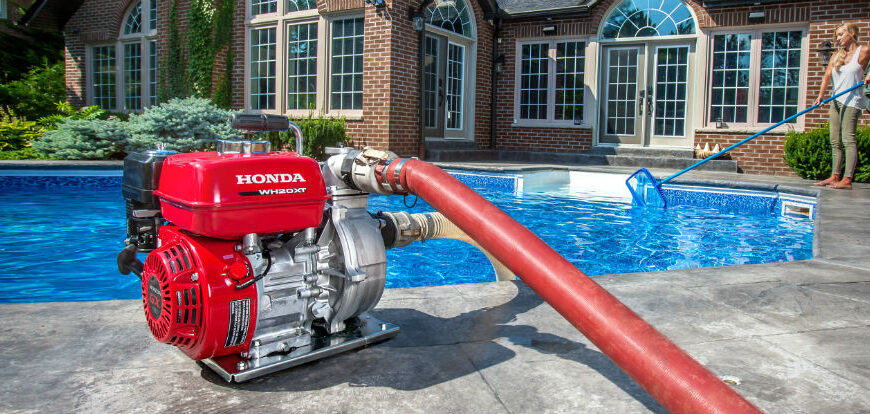
You will only need a power source once everything is properly set up, along with maintenance and cleaning at intervals specified by the manufacturer. If you wish to draw water from shallow sources or a pond – for example, for irrigation – a portable transfer pump might be suitable, as well as for filling and/or draining your garden pond, swimming pool, or water tank. This small device requires no complicated preparation before use; it’s ready to go immediately after refueling. With its 110 liters per minute water delivery capacity, light weight, and quiet operation, it’s a real help for tasks around the house and in small gardens.
If this isn’t enough, because you need to tackle a large volume of water suddenly, for example, emptying a flooded basement or a large swimming pool, and you don’t want to spend all day pumping, that’s when the real heavy-duty equipment comes into play. General water and sludge pumps available on the market, with capacities between 500 and 1600 liters, can quickly restore order wherever they are needed.
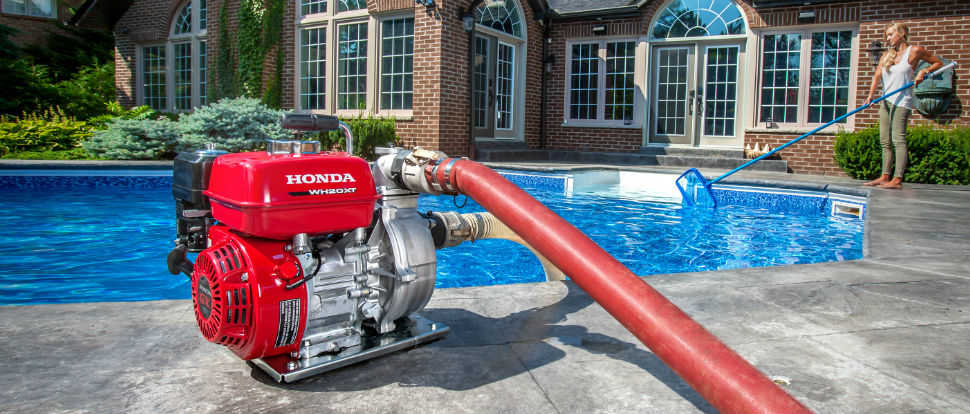
Consider that filling or emptying a swimming pool of approximately 20 m³ can be done in as little as 12 minutes with a high-performance device! For your flooded house or basement, you can call the fire department, who will, as soon as they are able, use their high-capacity pumps to remove the water – if there’s somewhere for it to go. However, after heavy rainfall, you might have to wait days for this, as the precipitation likely caused problems elsewhere too.
Alternatively, you can acquire a reliable machine yourself that will be available whenever you need it – because we know that every minute counts in an emergency. For pumping muddy, debris-laden water, choose a so-called sludge pump, which is designed to handle small pebbles, debris, and floating matter without issues. If you are already collecting rainwater, you might still need a pump for irrigating from larger tanks. For handling non-clean but homogeneous liquids (e.g., pesticides, liquid fertilizers, food additives), there are specialized products with plastic pump housings that are acid and alkali resistant, making them specifically recommended for working with chemicals. However, after proper cleaning, they also perform perfectly as general water pumps.
Only handle food products intended for human consumption with certified pumps designed for this purpose!
A Little Physics
As a novice homemaker back then, I had no idea what suction depth was or how much that certain 1/2/3… Bar pressure could be. I didn’t know why it was important to me when all I wanted was to fill the swimming pool in the garden. Then, with the help of a diagram similar to the one above, the picture became clear; I understood the meaning of each concept and why it’s good to be aware of them.
So!
The total head is the sum of the suction depth and the discharge head (in absolute terms). A pump with a 5 Bar pressure capacity can achieve a total head of 50 meters, while a 3 Bar pump can achieve 30 meters. Transfer pumps can generally draw water from a depth of 6-8 meters, so for deeper sources, you will need, for example, a submersible or well pump. Generally, it can be stated that the performance (flow rate) of pumps decreases with increasing total head, but the extent of this decrease depends on the combined presence of many circumstances.
These can include: product purpose, quality, specific gravity of the liquid, diameter and length of connected pipes, number of installed elbows, liquid temperature, suction depth, discharge head, etc. Water Drainage Water flowing from house roofs can be directed into water tanks or your own soakaway system, and if desired, to dry land areas – covered, rain-sheltered spots. Ensure that water never continuously washes against the side or foundation of your house, as this can cause further problems in the long run.
If you collect water in a tank, ensure that water drainage is still managed after the storage container is full, so it doesn’t flow back under your house. A smart solution can be to connect it with a filter built into the gutter. This automatically provides overflow prevention.
When the tank is full, the filter closes, and any additional water automatically continues through your gutter system to the aforementioned locations.
Before winter frosts, do not forget to empty and close your water tanks, as any water remaining in them can destroy them when it freezes!
Author: Ilona Bodnár