


AIR TREATMENT
Documents
Request a Quote
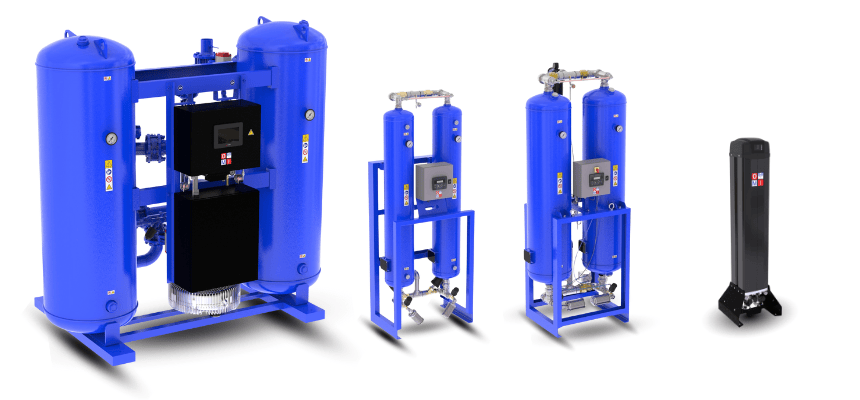
OMI KMD, HLA, HBA AND SFD SERIES
Adsorption dryers are essential for critical industrial applications where the +3℃ dew point of traditional refrigerated dryers is insufficient and there is a risk of freezing. These systems remove moisture using activated alumina, guaranteeing Class 2(≤-40℃) or Class 1 (≤-70℃) purity.
Traditional Heatless (KMD / HLA series)
These dryers are the most common on the market and stand out for their simplicity:
Operating principle: They use a portion of the already dried air (15%) for regeneration (purge air), which is then vented to the atmosphere.
KMD (Karst Modular Dryers): Compact design, suitable for Point Of Use solutions. Aluminum extruded housing, with IP54 protection.
EMS (Energy Management System): Models with the EMS option (e.g., HLA) use a high-precision dew point sensor to control the cycle time, thereby reducing air loss.
Special Energy-Saving Solutions
The two most advanced OMI series focus on avoiding air loss, optimizing operating costs:
HBA (Heated Blower): This technology reduces compressed air consumption to zero for regeneration. It draws ambient air with a blower, heats it with a heater, and uses it to regenerate the adsorbent material. This guarantees a -40℃ dew point, but may involve higher initial investment and electricity consumption.
SFD (Sub Freezing Dryer – regenerative cooling): This unique hybrid technology uses a refrigerant for regeneration, thus consuming no compressed air. It achieves a -20℃ dew point (Class 3), with extremely low maintenance costs, and requires 40% less space.